
Recently, I just received my dissertation mark. It was a great score. (I got an A+!) I expected the score to be that way, however, so I don’t really feel the excitement (boo…) There are several things that I’d like to do differently so I could be happier with the process.
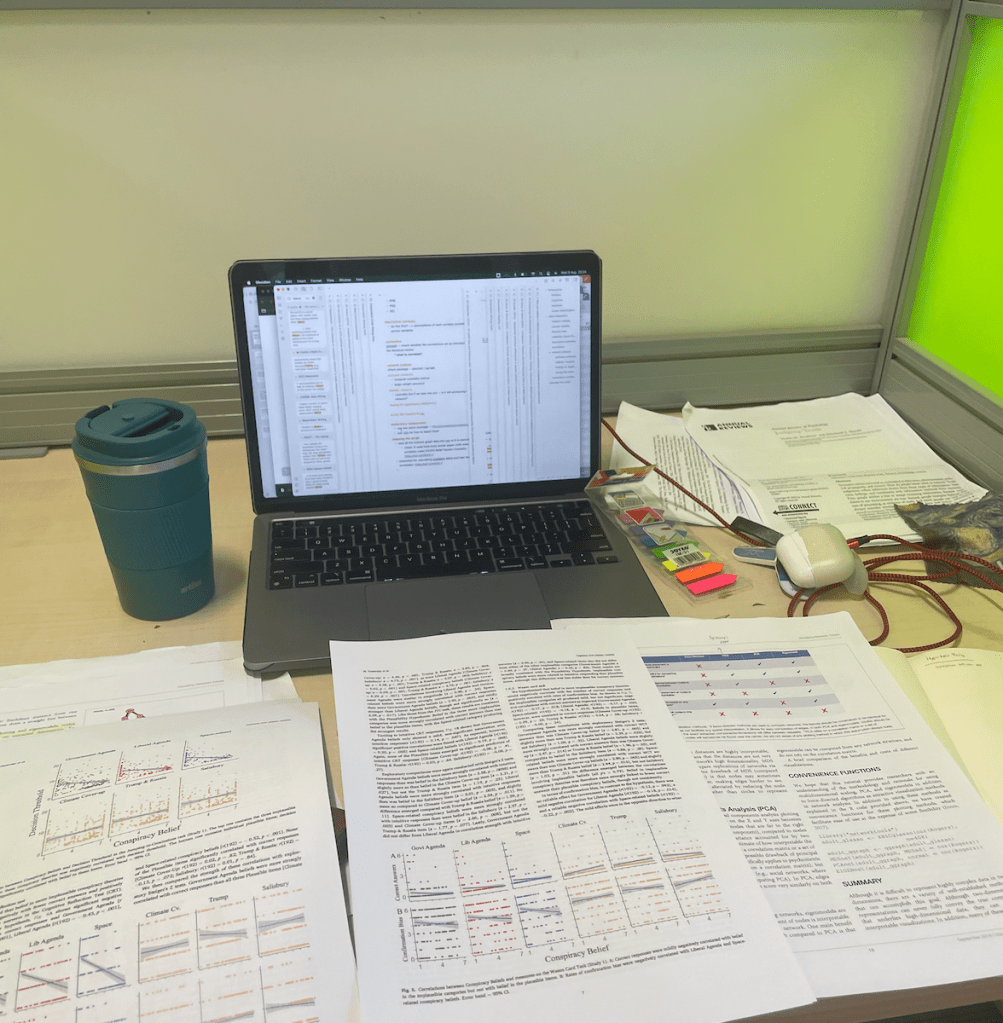
I remember doing my dissertation in the library with a lot of frustrations. We were given the entire 3 months to complete this end-to-end project with the topic of our own choice. There were more than 30s topics and we had the option to select 10 out of 30, ranked from the most to the least wanted topic.
For me, I chose conspiracy theory with the supervisor that I knew I would truly enjoy my time with. My bachelor’s thesis was an experimental project related to fake news, so conspiracy theory was not really far from that.
I had a good feeling about doing this dissertation. In a group of four students, we had our first meeting to set expectation about the expected outcome and supervision. My supervisor wanted us to collect primary data from survey. That’s basically my day-to-day job! Excited with the prospect of this project, I did not really plan out my own roadmap nor sticking with it. That’s my first mistake.
I should have known that too much confidence would get the best of me and my procrastination.
If I could redo the whole process I would try these things: 1) Focusing more on connecting the dots, 2) Make use of reference management system early that fits my writing behaviour, and 3) Working with and not against my energy level and rhythm to work.
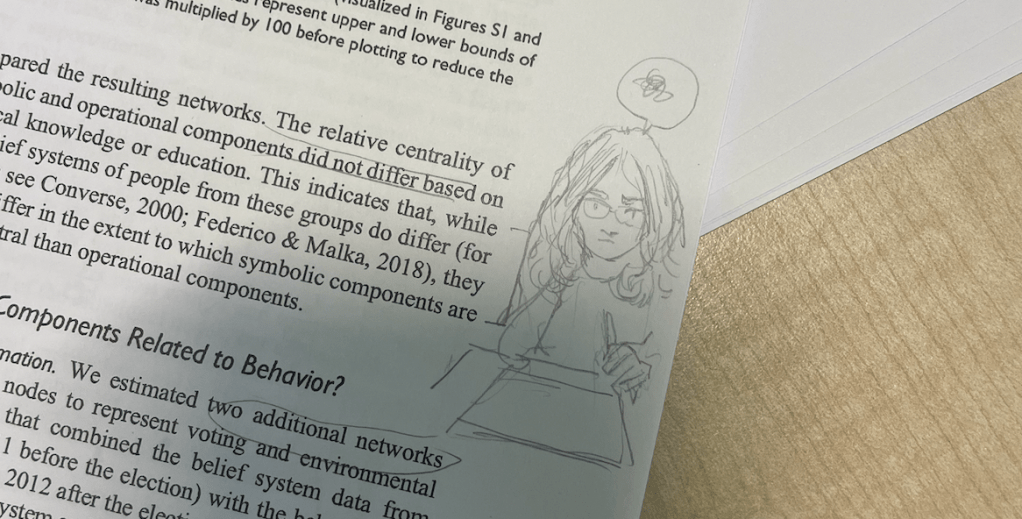
Let’s start with the first one:
1. Focusing more on connecting the dots
I tried to read all of the papers thoroughly one by one. This is not wrong, but a lot of time could have been saved if I actually wrote something every time I finished reading a research paper. Oftentimes, I just forgot the main argument of that paper and it is hard to tie that knowledge to other papers that I read in the future.
I thought it was hard to write every time I finished reading a paper. However, when thinking research papers as a network of knowledge, it is easier to get why I need to write. It is harder to recall everything when you need it compared to just writing it in the first place. It’s all about delayed gratification afterall…
Early in my process, I had a difficulty of distilling down my broad research idea into specific research questions to answer. I spent too much time “thinking”. I was stuck with my own assumption of “thinking” that does not involve “writing”. When I did not write, I did not remember what I read, so it is hard to think! Too bad… so much time got wasted in the reading process.
I only started to diligently write what I learned after reading around 30 papers (sigh). An example of the takeaway I usually write about a paper:
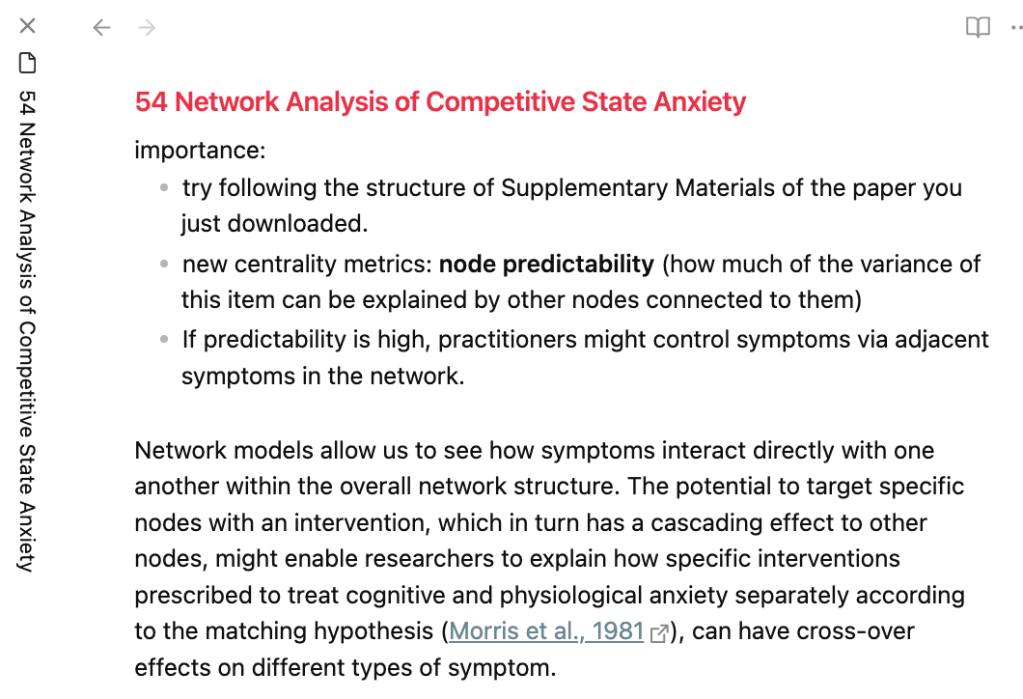
2. Make use of reference management system early that fits my writing behaviour
I was too confident that I could do the reference compiling at the end of my process. I used Google Scholar and imported the BibTeX and copied the references to my draft. With BibTeX, I can just easily transform the paper details into any type of citation format (click here for more info on BibTeX). However, I haven’t decided what platform I wanted to use for writing. There are a lot of options here, Microsoft Word, Google Docs, R, Overleaf, and so on.

I planned to write on R using the markdown format (.rmd) since all my codes for the data analysis were there. I kinda think this was because I only started writing properly after getting the results from the analysis. For me, writing in Rmarkdown is unintuitive because I cannot really see the actual writings that will appear on the submitted version. I need to switch between the “Visual” and “Source” tab. Also sometimes I could not knit the document into .docx / .pdf when I made a mistake in writing the text formatting. So much friction! It frustrated me a lot.

I then used Obsidian, my note-taking app that is also using markdown format, to write the draft along with the takeaway from reading papers. It has a good enough layout and formatting, but bad with references. At least, it was something to get me going.
Here is some preview of my draft on Obsidian, look at how varied the citations I wrote early on:
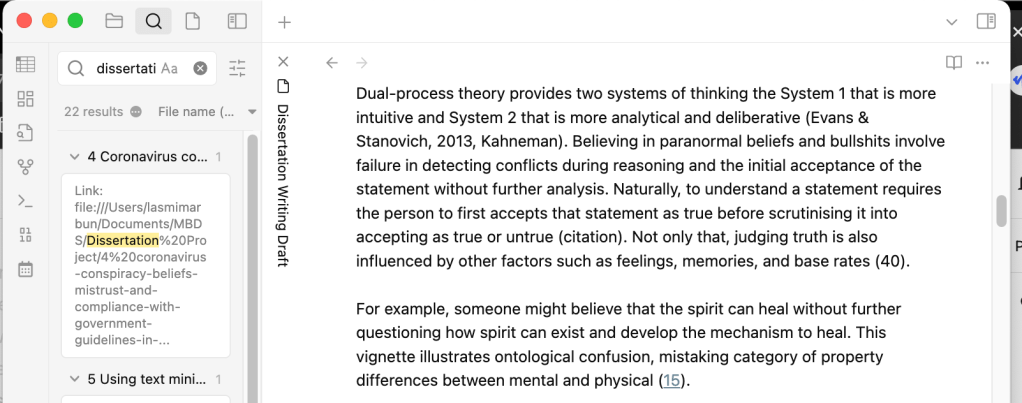
Being overly confident, I was not taking into an account that my work should be able to be seen by my supervisor when I submit my first draft. I sloppily just copied everything from Obsidian into a Google Docs. This was a hectic but good move. At least, I got all the feedback early on all the key points I wanted to write since I just dumped all of it in the draft. Sorry for the hassle, supervisor. But it’s good to not be too focused on getting them all pretty and well-formatted.
The citations were still all over the place, but I got my supervisor commenting directly on the Google Docs:
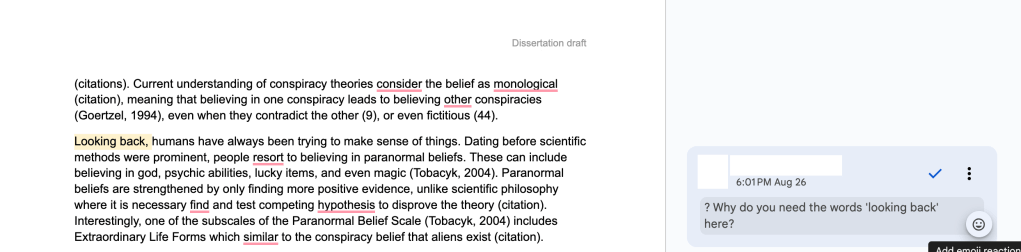
I got lucky that my supervisor was not the type of person that requires the students to send them the “pretty” format before willing to review and give feedback about the content. It may not be the case for different supervisors.
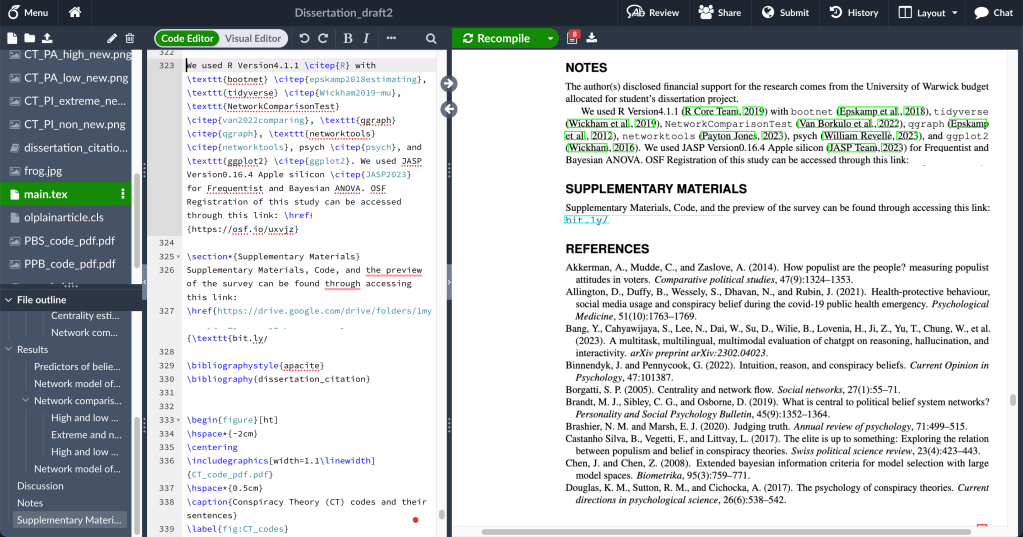
In the end, I used Overleaf. You don’t need a subscription for the full capability, but it was available with my campus email (and maybe your campus email too!). I think the features in the free version was good enough. For me, I should have started using Overleaf in the beginning of writing my first draft since it’s so easy to look over the citation reference when I want to re-read the paper again. I don’t need to worry about formatting that much because the spacing and margin just makes sense, even when inputting tables and figures. It can be tedious the first time—LaTeX can be said as a language in itself. However, it is worth learning if your works involve a lot of mathematical formula and code.
Also! It just feels so rewarding to see your paper in a pretty format, just like the ones published in top-tier journals. Some preview of the Overleaf display:
3. Working with and not against my energy level and rhythm to work.
Throughout this process of finishing my dissertation, I now understand my rhythm to work better. I am a person that needs some time to warm up to focus. I need around 2 hours to get my engine started.
Usually this begins with me waiting for the stopwatch to reach 30 minutes of doing work without distraction. Once it is achieved, I set a 10 minutes timer for my break. Then I will increase the focus time and the break time incrementally. This is similar to the Pomodoro technique, but with increments. My focus would not break that easily once I reached the zone, so I reckon that I could increase my focus time. Besides, some analyses require a lot of uninterruptable work. I remember having a total of 8hrs of not browsing social media and just doing the work. Some days I only got around 4hrs. Other people may be different.
Here is a preview of my stopwatch by the end of the day. One lap means one session of focus work that is distraction-free. I paused the stopwatch when it was time for a break and continue to another lap for the next focus time.
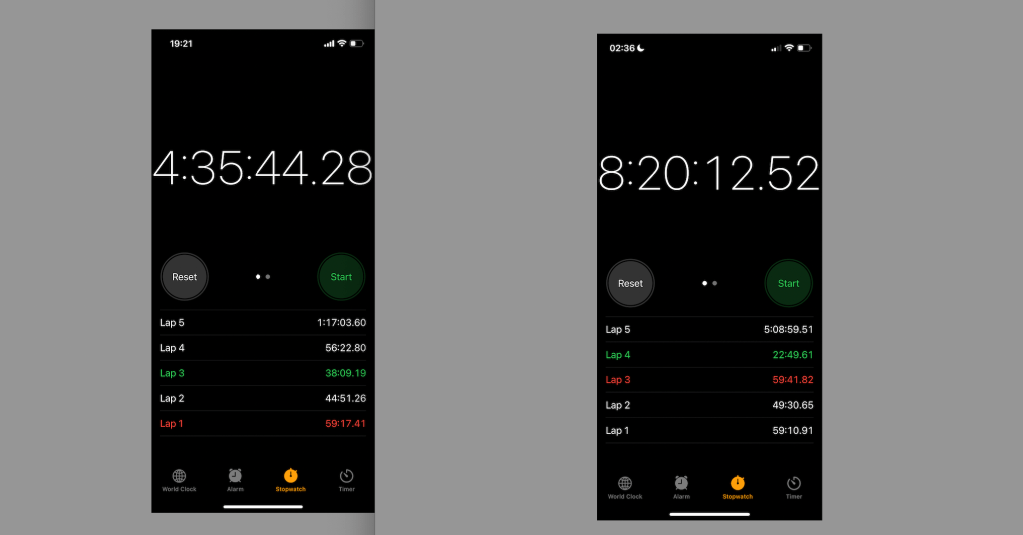
It just feels good to me to see my input metrics being achieved, which will lead me to completing this dissertation. It is important to not beat myself up for not achieving a lot of work time though!
Remember that: work_quantitiy != work_quality
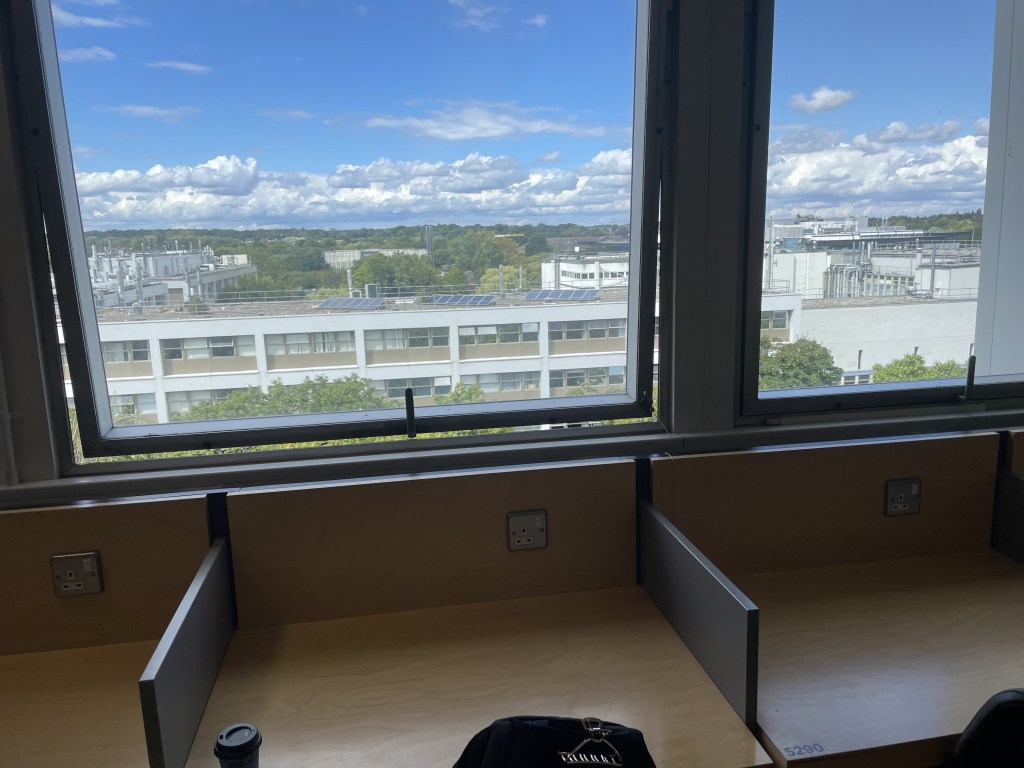
I also need a different place to not be distracted. For example, if I study in my room where I sleep, my brain will associate that place with signals of “wanting to sleep” hence making it difficult for me to focus. I went to the library most of the time to do the work. Looking at the sky in the background helped me to focus!
This means that the later I started my work, the later I got back to home. There was a time when I got back at 11pm from the library. I needed to prepare the meal plan or I would forgot to eat. During this phase I think I lost about 3 kilos!! An honorable mention to my boyfriend that reminded me to report what I ate on the day and (kind of) scolding me if I did not eat properly. I did not meet him in the weekends before the deadline because I was too anxious hahaha.

All in all, it was a great experience. I feel that I am more confident in pursuing a research-based job. The mark I got was great. Not in a way that I did not expect, but in a way that I could see it coming. Another side note, I wish that this project can be more practical because this is more on the theoretical side. But it is what it is. Now I know better that I can work on something more academic and have more confidence in it. I learned a lot in a considerably short amount of time. I can do it if I put my mind into it.
I think it is a good practice to reflect on the process and not only the outcome. I always have the notion that when something is difficult/painful, that means I have not found the most optimal way to do that. Just like exercising! Maybe I need to correct my form so the next time I do similar work, I can be more effective with my time and effort. I could have not skipped meals and rested more properly!
Thanks for reading down here, hope you get something worthwhile and I wish you success in your dissertation or academic writing journey! 🙂
 Lasmi's Thoughts
Leave a comment