

*edit: by the way, the code for this project is now up on this Github page.
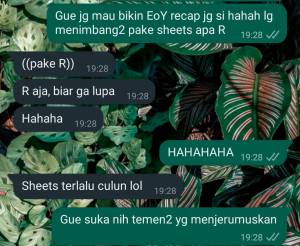
Hi there! I’m back to review how my year was, but now I’m not using Google Sheets despite my love and passion for that app. I’m using R, a love x hate alliance that I built this year in order to prepare me for my new jobdesc as a quantitative research specialist in my new workplace*. I love it because it helps me analyze more complex things, but I hate it because some functions are built inconsistently, depending on the author. A dilemma of an open-source programming language.
*(P.S. Don’t tell them I actually just learned R by the time I got accepted, lol.)
I still use Google Form to make easier daily and weekly recollection of how my life went. It’s effortless since I can always fill it with my phone even when I am sleepy. The journaling will focus on feelings or emotions (recorded daily) and things I have learned and am grateful for (recorded weekly).
Anyway, thanks my friend who nudged me to make these analyses in R, I owe you for always pushing me in doing the extra miles 😄:
1. How did I feel?
Have I always been this chill?
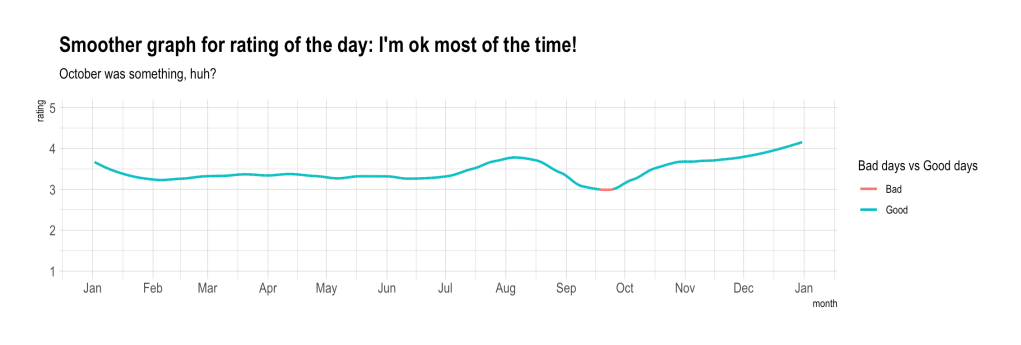
Well, if we smoothen up the days into the week, things do not become that extreme. And yeah, something happened in October but it’s resolved! I was the happiest after my birthday and changed job to where I work now in July-August. I love my workplace right now, so supportive and the difficult thing is for how to do things right with some creativity to solve problems that no other have cracked before.
(If you’re interested in education & technology, we still have openings for some positions!) This is not a paid promotion btw lmao.
Daily rating

I filled a question daily that asks me how I would rate my day from 1-5, with 5 is being so positive and 1 being so negative.
This results into a line chart looks like something out of a heart rate monitor. With the ups and downs, like a heartbeat. Although if we look at it from a distance (by using geom_smooth), things are… pretty mild.
My hypothesis is that work contributes so much to my happiness. But, let’s check with the data lmao. I might be wrong.
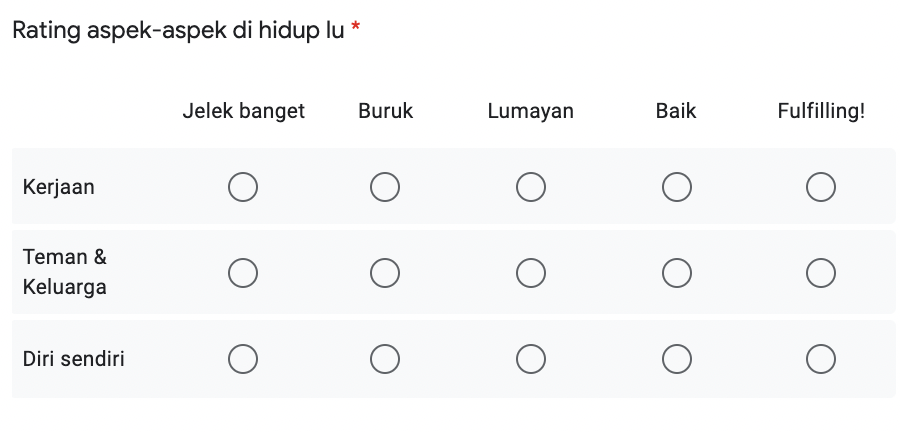
At the end of the week, I asked myself to rate how my work, friends & family, and self. I did not put them in the daily form because the dynamic cannot be that different day-to-day. These 3 categories (left) will then be correlated with general rating of each day (right).

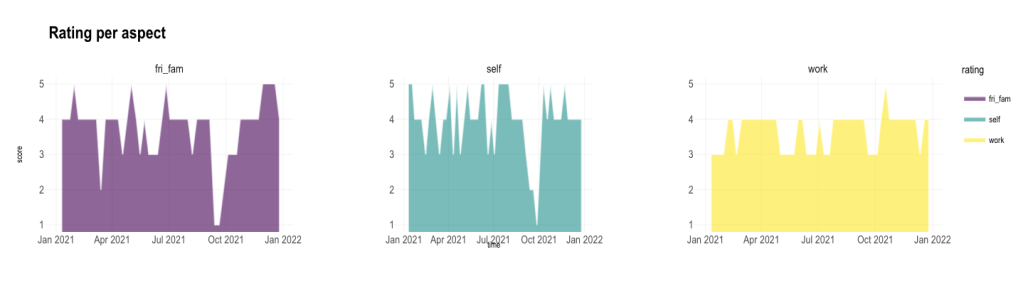
Before it, let’s see the descriptive stats. How I rated these 3 aspects weekly in the span of a year. Wow. Work is relatively stable compared to the other 2 categories friends & family! (Really did not expect). Ok, hypothesis was refuted. Maybe, the external environment is more difficult to control, hence the relatively stable rating. But look at the ratings though! So stable at 3 and above during the whole year, compared to self and friends & family.
Ok, but how does each correlate with how I rated my days? They’ve been only ratings and not “what” I felt.
It’s time to…

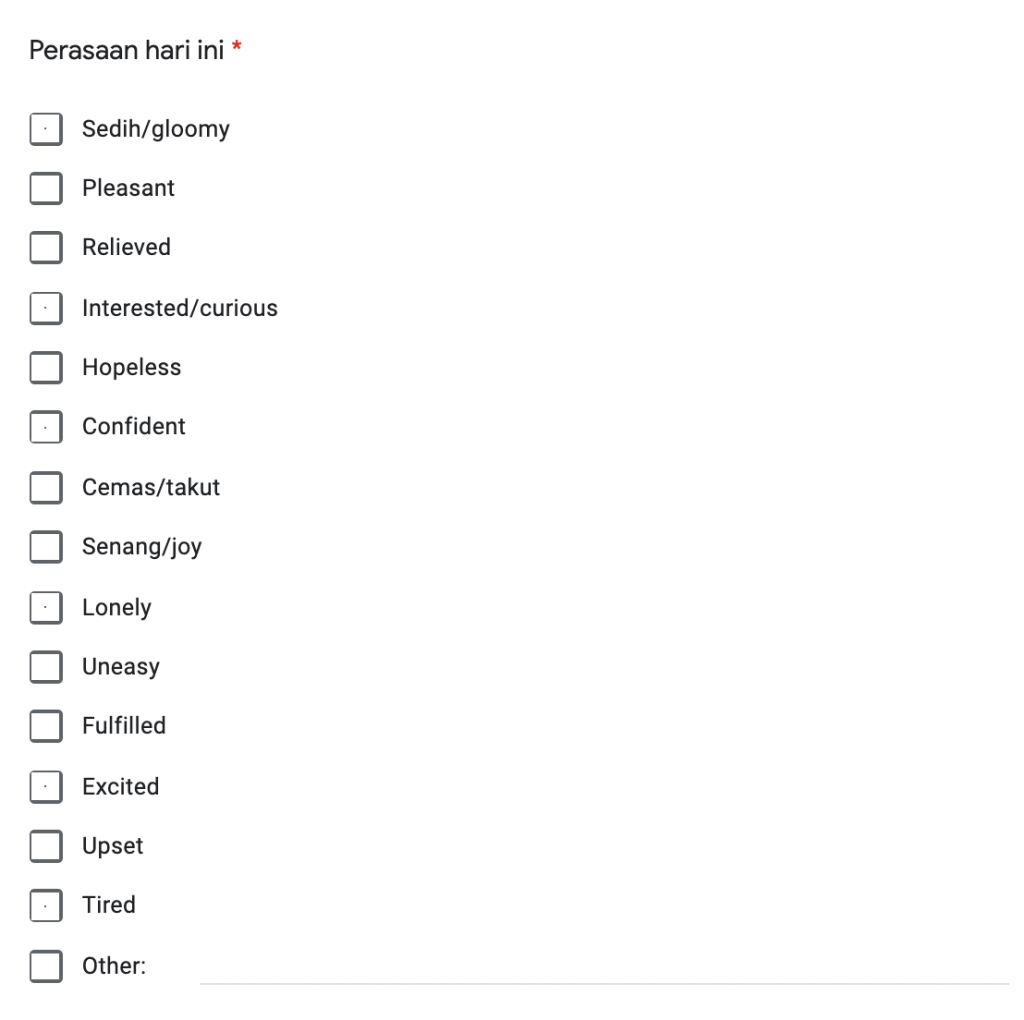
In the Gform, there’s a checkbox question that asks about how I feel. That looks like this:
I can indicate multiple feelings during the day and in the analysis, I’m keeping a tally of each emotion for everyday. This is something beyond GSheets can do, so… thanks R!
Let’s visualize the correlation with corr:

The rightmost column is called “rating”. It is a variable that records how I rate my day from 1-5. I am trying to correlate the answers from “how do I feel” to this rating. As this “how do I feel” question is also being asked daily, I think it’s fair enough to correlate this statistically just to see which ones have the biggest magnitude.




Size does not mean that it’s more important. It’s just… a cropping issue, sorry.
If we look at the rightmost cell, the correlation index for the general rating of how I feel during the day, being happy and confident contributes a lot to how I feel daily. Meanwhile being lonely and gloomy or sad make me feel like having a bad day.
Hmm… I’m better off maximizing how joyful and confident in day-to-day interactions and avoid being lonely and gloomy. Maybe try some social interactions? Well, it’s the pandemic, guys.
But how to do it?
Like, how can I be sure which activities contribute the most to how good I feel about my day?
Thank goodness I am that prepared. I also have questions that ask what things give me energy for the day and which ones drain me. This is an easy strategy I learned when I used to consult with a mental-health practitioner back then when I was still at my campus (it was free, thankfully 🥲).
Ok. Let’s see what kind of things give me energy so that I can do them more in the next year?
Here comes the network of bigrams with ggraph! I visualized the texts I entered onto these two questions and how two words relate with each other, including the direction. I just learned it yesterday and was extremely helped by the tidytextmining resource for learning.


But, sir… There are a lot of texts. I mean, A LOT!!
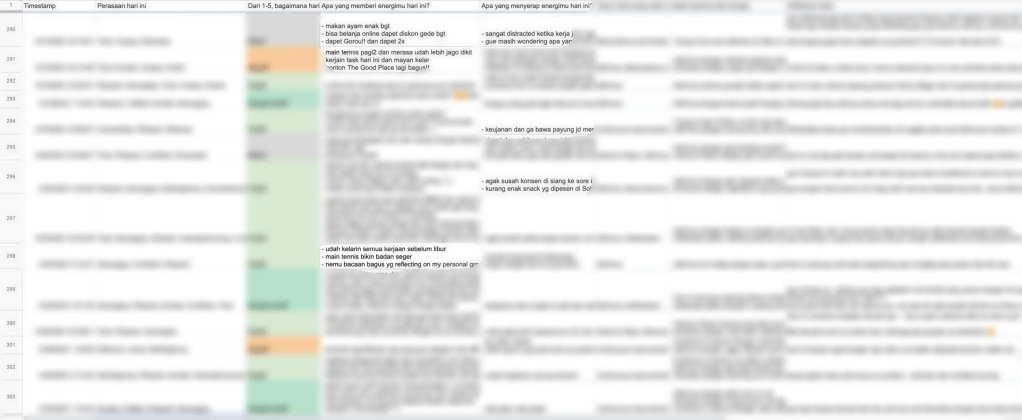
That’s why we should keep learning, right?
In the future, data will be more readily available. It would be such a waste if we cannot analyze them to guide us in making better decisions. Everything is now digital, we even think-out-loud on our social media. A lot of data to gain insights from.
Asking help from R
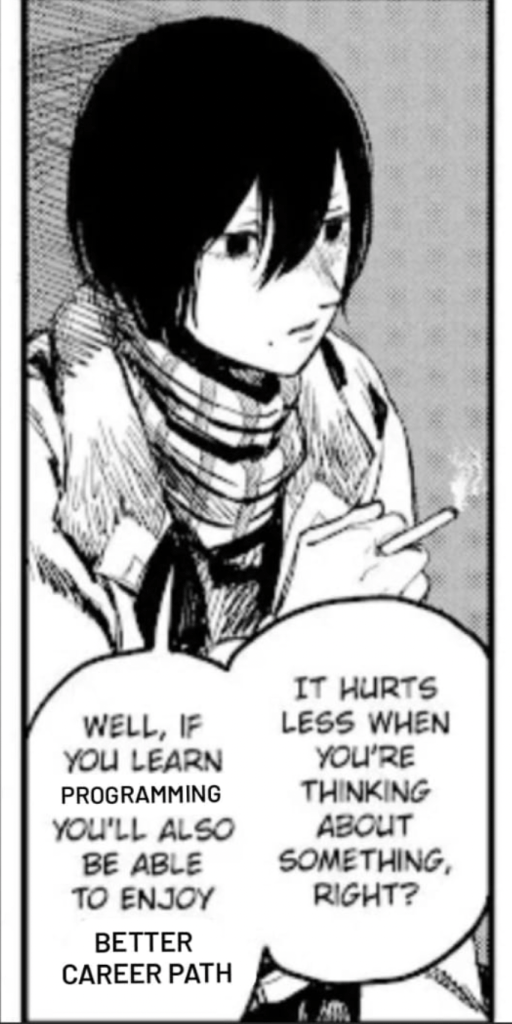
Late-night conversation with R
Me: “Ok R. Help me. I want to understand this data. Grant me your power.”
R: “You have to understand me first.”
Me: “I’m afraid that it’d be difficult…”
R: “It will be. But you need something to distract yourself from, right?”
Me: “Well?? You’re not wrong.”
(proceed to spend the whole night to learn this.)
*exciting drum rolls*
After many many hours, here it is:
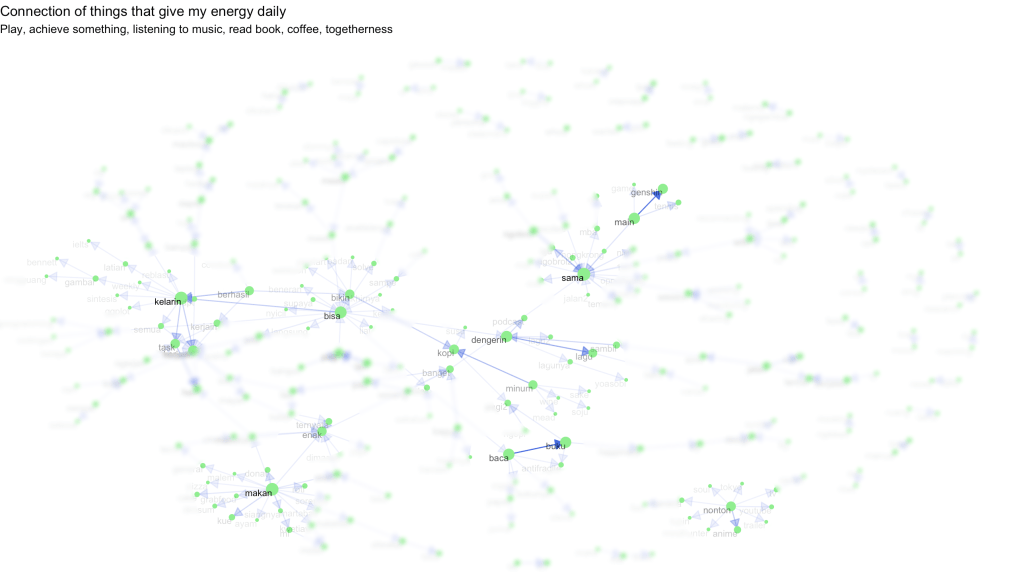
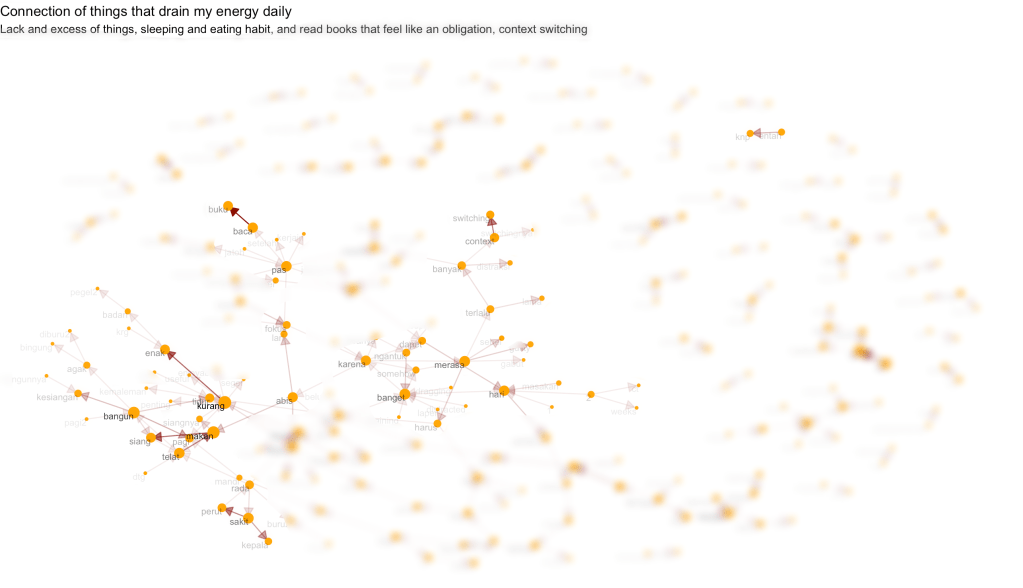
Let that feeling sinks in.
R is amazing right??
That’s how I felt the first time this analysis turned out perfectly.
Nope.
Even when it’s not this visually appealing at the first time, I am amazed at how helpful programming is in aiding me to think through complexity. I went through several iterations before actually producing that kind of visualization.
This brings back memories of how excited I was when learning Visual Basic when I was in Junior High School.
Ok, moving on.
2. What Did I Learn?
R, duh. Just kidding.
So here are the things that give me energy and those that drain me:
Things that give me energy:
- Reading books
- Playing Genshin*
- Listening to music
- Drinking coffee
- Running/exercise
- Successfully completing a task
- Watching shows
*just wanna brag that I’m still F2P hahah
Things that drain me:
- Reading books
- Bad-tasting food
- Lunch
- Physical discomforts (headache, stomachache)
- Context-switching
- Waking up (late/tired)
- Excessive or lack of things
Wait. Seriously, why reading books are in both categories?
Two quotes from one of the day where I wrote “baca buku” as draining:
“merasa missing out dan unproductive dengan gak baca buku dan malah nonton series”
excerpt from one of the day in November.
“gak ngelakuin rutinitas, either baca buku atau ngegambar.. merasa fail for today :(“
excerpt from one of the day in July
The more I reflect on it, I did not read that many books but I pushed myself to oblige into reading. I did finish about 10 books this year, but some books felt forced to be read. I could not say I enjoyed my time. I think I should pick more relevant books later, or wait until I’m ready to read them. Learning does not have to be from a book, right. I guess that’s what it takes when I make one of my 2021’s resolution is to read 2 books per month. Too difficult and not meaningful.
Things that drain me are more prominent in some sort of physical irritations. Maybe all the bad moods I have were the result of me not taking care of myself enough physically. I used to ridicule the simple but prominent connection of physical fitness to mental health. Now I have atoned for my sins. Let’s run more, eat and sleep more properly.
For the activities that give me energy, I’m trying to be more deliberate to incorporate more of them into my life. Or maybe trying new things that can make me more mindful since drinking coffee daily was a new habit I created since I get into the habit of making a manual brew coffee. Thanks, Lin, for the nudge!
Beyond that, I also tried to learn things weekly and record it in the weekly GForm.
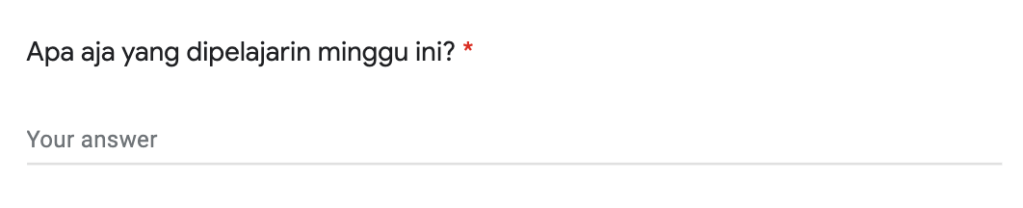
This open-ended entry is going to be analyzed with the same bigram network:
Can you guess what it’s about?

I learned to create (buat), be able (bisa), more (lebih), and understanding deeper knowledge (tentang-what-it-means). Pardon my Jaksel-lingo.
I kinda expected there will be more hard skills, but this is good! Learning does not have to be more about new things. Crystallizing the older ones is necessary too.
Oh! A little easter egg within these strains of connection:
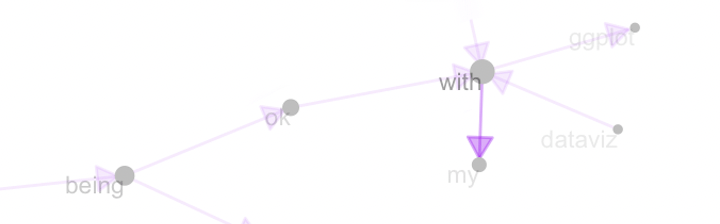
This reflection is very thorough, but…
The Caveat
I read in Happiness by Design, Paul Dolan mentioned that we have 2 types of selves: 1) experiencing self and 2) reflecting self. The one that is in the moment and the one that is rationalizing the past decisions we have made.
That book argued that in order to change how we feel, we might as well change how we do things. Sometimes feelings are just the reflecting self speaking, but the experiencing self is being discounted. Maybe that obligatory dinner did not suck so much when you can actually enjoy the dishes when you were there. Yeah, that convo was bland, but the moment you saw the scenery was really breathtaking and it’s been a year since you’ve gone out to see this kind of view.
This reflection is good to see how much I’ve progressed, but the day-to-day reality might be slightly different from this. If this reflection only brings more stress to how I regretted how I have lived my life or makes me too careful to enjoy living in the moment, then this post will be a failed attempt.
Fortunately, I truly enjoyed my time tinkering with the data and thinking through my thoughts to convey what I want to say with this blog post. It is more about what we pay attention to. Attention is too scarce not to care about. We have such a limited time.
I will always remember this quote from that book:
“You only have so much attentional energy and it will make you happier, more efficient, and healthier if you are able to focus it properly.”
Happiness by Design – Paul Dolan
What’s Next
I tried to adapt his framework and add a little mix of James Clear’s Atomic Habit:
- Departures from happiness -> what drains me? what misconception about happiness that I have hence not maximizing how I spend my time? what kind of unknown things that I have not tried to increase my happiness?
- Decide -> what kind of habit that I want to change to realign my attention?
- Design -> how might I incorporate that habit in my daily life, as seamless as it can so it can be part of my identity?
I leave this part open for you as the reader so you can also implement them in your life if that might be helpful.
If you are that classmate who like to compare notes, here is mine:
Key insights and decisions made:
- Work did not correlate that much with my well-beings compared to last year. I’m relatively happy during 2021, so the disturbance (which is more prominent) are coming from myself or relations with others.
- I will try to explore things that can elevate my experience from relations with others and myself.
- Reading book is both draining and recharging. It is because I pushed myself to stick with it and strayed from the intention to learn.
- I have to deal with this love x hate relationship the way I did it with R 😂
- Investing in my physical-wellness is worth it. I might want to buy new running shoes and other healthy foods that will push me to exercise and eat healthily. Maybe also a better sleep schedule so I don’t wake up tired and easily irritated.
- I will try to focus more on physical-wellness.
- Investing time in brewing coffee manually is also worth it. I became more mindful and actually my coffee is usually as good as cafe’s so I can also save some pennies to be invested in other things as well.
- I will continue this and maybe exploring new activities that can make me more mindful.
The challenge:
- HMW make myself in a situation where I am more confident and less lonely so I can elevate my experience, be it alone or with others?
- HMW make myself adopt a learning habit that does not have to involve reading?
- HMW be more attuned to my physical discomforts so they do not disturb my flow?
- HMW enjoy the moment while also being aware of how my decisions turn out?
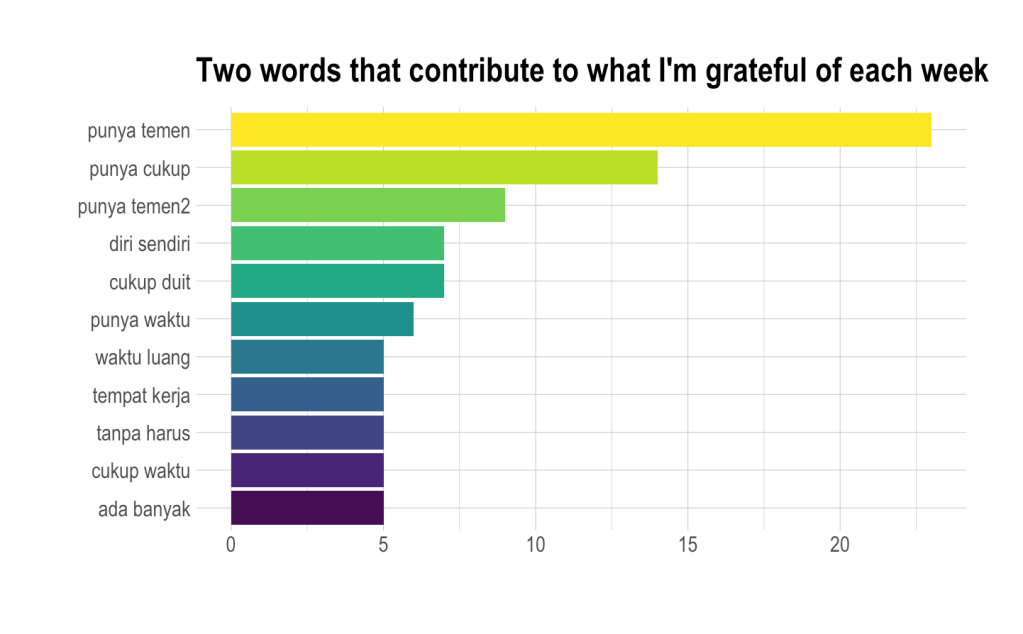
3. Things that I am grateful for
Things that I am grateful for during this year: friends, friends (again), having enough time, freedom, and money 🙂

Thanks for reading! Hopefully this post can do justice to those 50-ish weeks and 300-ish days I recorded in GForm during 2021. Hope you enjoyed your time in this post 🙂
Nitty Gritty:
- Yes I removed stop words like “yang, dan, atau, yg, klo”, etc. before doing any text analyses
- No I did not do sentiment analysis because I do not consider it as important and I don’t know where to get the sentiment library that is reliable for Indonesian.
- Yes, I just uploaded the code here: https://github.com/lasasimi/EoYreview if you’d like to see the code. Would be glad if you guys have any inputs to make it better! Feel free to chime in 🙂
 Lasmi's Thoughts
Leave a comment