
The weird thing is that I use Google Sheets for my diary. Shouldn’t a diary be super colorful and personal? Does not this sound like too much work??
Firstly, my Sheets diary does not lack of color. I realize that color-codes are pretty helpful as indicators of how I feel during days, so I use it under ‘conditional formatting’ function to color the cells (e.g. green means “good”, red means “bad”).
Secondly, I agree that using Google Sheets might look like I am making myself do another work. It is!! The value is when it actually means that I am truly working for my self-improvement. (Yay for more mentally-healthy me).
I spend lots of hours to work on other people’s problems (well, company’s problem is the owner’s problems, indirectly). So why don’t I work on my own too?
Using Google Sheets can provide clearer view of how my life looks like. As my own memory often is hazy and biased towards things in the past, I think it’s great to write down notes on the moment I felt the experience. As it is tedious to insert writings by myself, Google Form comes to the rescue so I can have same variables for each inputs. In a nutshell, this method already covers the basics of journalling as I can have the journalling prompts on the Google Form question format. You can also have color-(codes)! And lastly, you can have quantitative insights about your life with Google Sheets.
So the journey begins.

I use Google Form to fill in my journalling prompts. The goal is for me to better reflect on my past experience. As someone who believes that pain + reflection = progress, of course, I can’t help to just free some time for sole self-reflection.
Besides, effective learning comes with some moments of reflection. I use Kolb’s Experiential Learning as a framework to things I learn. It basically tells us that learning begins by having concrete experience that you can reflect upon to get the abstraction of what makes that work or not work in order to better perform in similar situation.
I make it daily and weekly. For daily, it’s more about how I observe day-to-day feelings, the emotions, ups and the downs, unresolved thoughts, and some space for other things that I want my future self not to forget about.
For the weekly, I focus more on learnings. What I learned on that week and what I need to learn next. What hinders me during that week and how I plan to solve that. I also rate my 3 aspects in life (self, work, and friendship) in order to gauge how objective I assess my happenings in the week compared to how I was daily.
You know, sometimes I make worse judgement about how my week went even though it does not truly reflect on the daily reflection I made. And that’s why for the last part, I also add the gratitude journal prompt.
It’s basically a psychological intervention to make me more mindful and hopefully to make me happier. Because of the nature of the intervention, I cannot put that in daily because it just increase the chance I have nothing to be thankful of and hence perpetuating the negative outlook I am having. So I am putting it in my weekly.
Sometimes I do that when needed. I need that when I feel stuck in life. When life seems to be only draining. It starts with red alerts that I did not notice. I literally put the red color in conditional formatting for better visual clarity (it’s a function in sheets where it auto-color cells for specific condition). And it helped me when I was in a burnout. My sheets showed red color and that alarmed me to do something. And I did something about it and got out from it. Haha! I beat myself. #personalachievement
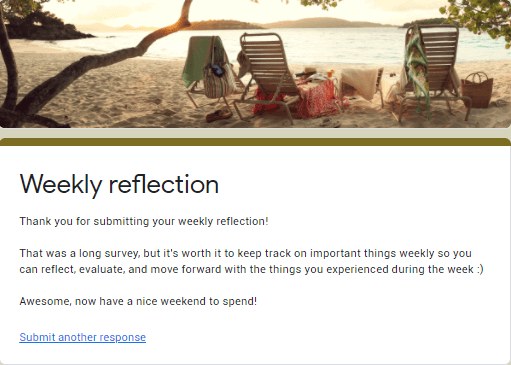
To add a more personalized touch, so I don’t feel like doing labourous work, I put a personal memo. It’s by adding emotional sentiment at the beginning and end of the form so I will be more motivated to fill these forms again.

After a while, I realized that incorporating self-reflection using Google Forms is actually beneficial. I am trained to recall things so recalling things at my work becomes easier. I also notice that to be a researcher, especially in user research, being able to reflect upon my own experience is a useful skill. It makes understanding the user easier because I already have some frameworks ready to be matched with the person I am interviewing or observing.
It makes me more self-compassionate about myself in a way that I assess how I perform more accurately.
It makes life more meaningful. Asthe moments to be remembered become more instead as I put them down so I don’t forget it.
I guess the capacity to understand others roots from having thorough understanding about yourself first. Life is a long journey of researching, is what I believe.
After this, I will post my 2020 review with the help of this tool as to close this year with one last post. I can remember my 2020 more vividly and gain more insights on what’s good and what’s not, in a more specific manner (lol). If you’re curious, stay tuned!
 Lasmi's Thoughts
Leave a comment